
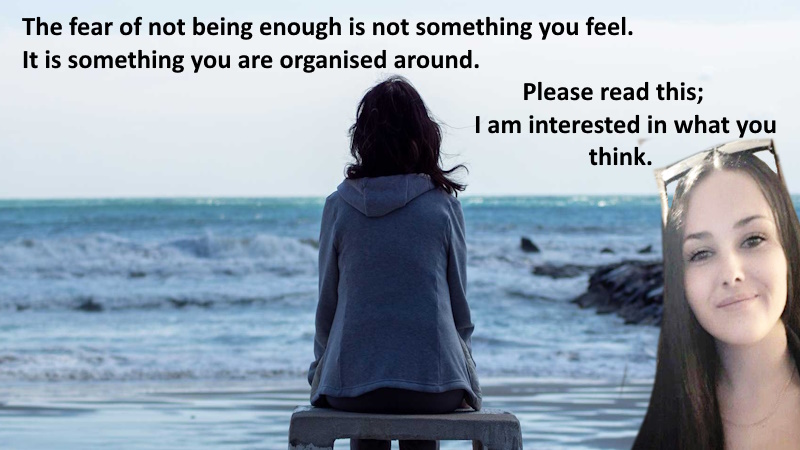
The fear of not being enough is not something you feel.
It is something you are organised around.
It does not sit at the surface waiting to be named.
It lives in what Carl Jung’s unconscious would call the unseen,
the part of you that does not ask for permission
before it decides the shape of your life.
You do not hear it as fear.
You hear it as truth.
As reason.
As maturity.
As the quiet voice that tells you to stay where you are tolerated,
instead of risking a place you might be fully seen.
And you listen.
Because what is familiar does not feel safe,
it feels right.
But that ‘rightness’ was built.
Somewhere, at a moment you no longer consciously remember,
you arrived at a conclusion.
That being left would destroy you.
That being alone would expose something in you that could not be survived.
And from that moment on, you did not live freely.
You adapted.
Not by facing the fear,
but by constructing a life that would never require you to.
This is how the psyche protects itself.
Not by healing the wound,
but by building a world where the wound is never touched.
This is the work of the complex,
it does not ask what is true.
It asks what must be preserved.
So your ‘choices’ become negotiations.
Not between right and wrong,
but between what you are
and what you are avoiding.
The people you remain with.
The roles you shrink into.
The limits you defend as if they were facts,
none of them are neutral.
They are the architecture of your avoidance.
This is the shadow.
Not the parts of you that are dark,
but the parts of you that were rejected, buried, and left to operate without your consent.
And what you refuse to see does not disappear.
It gains authority.
It chooses for you.
It speaks as you.
It builds a life that feels inevitable.
Until something in you begins to notice.
And that is where it becomes dangerous.
Because awareness does not comfort you,
it implicates you.
It forces a question most people spend their lives avoiding.
If this was shaped by what I could not face,
then what part of my life is actually mine?
There is no easy answer to that.
Because to see clearly is to realise
that much of what you call identity
was constructed in fear.
This is why most people turn back.
Because this is the threshold of individuation,
and individuation is not self-improvement.
It is self-confrontation.
It asks you to stop calling your patterns ‘personality.’
To stop calling your limits ‘reality.’
To stop calling your fear ‘intuition.’
And instead,
to see them for what they are,
Adaptations that once protected you,
and are now quietly determining you.
You do not have to change everything.
But once you see it,
you lose the right to pretend you don’t.
And that is the real shift.
Not that your life immediately changes,
but that your illusions no longer fully hold.
And without illusion,
you are left with something far more difficult than fear:
Choice.
And if you can see it,
even for a moment,
then something in you is already changing.
Because the part of you that notices
is not the part that is trapped.